
CULTURE IN GERMANY
Architecture
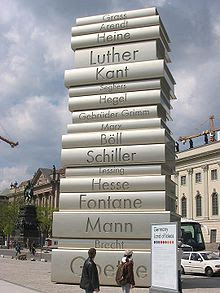 Further information: German architecture
Architectural contributions from Germany include the Carolingian and Ottonian styles, important precursors of Romanesque. The region then produced significant works in styles such as the Gothic, Renaissance and Baroque. The nation was particularly important in the early modern movement through the Deutscher Werkbund and the Bauhaus movement identified with Walter Gropius. The Nazis closed these movements and favoured a type of neo-classicism. Since World War II, further important modern and post-modern structures have been built, particularly since the reunification of Berlin.
Religious tradition
Main article: Religion in Germany
Picture of Benedikt XVI.
Portrait of Martin LutherThe German government has limited responsibilities for culture, which is devolved to the states of Germany, called Länder.
64.1 percent of the German population belongs to Christian denominations. 31.4 percent are Roman Catholic, and 32.7 percent are affiliated with Protestantism. The North and East is predominantly Protestant, the South and West rather Catholic. Nowadays there is a non-religious majority in Hamburg and the East German states. Germany formed a substantial part of the Roman Catholic Holy Roman Empire, but was also the source of Protestant reformers such as Martin Luther. Historically, Germany had a substantial Jewish population. Only a few thousand people of Jewish origin remained in Germany after the Holocaust, but the German Jewish community now has approximately 100,000 members, many from the former Soviet Union. Germany also has a substantial Muslim minority, most of whom are from Turkey.
German theologians include Luther, Melanchthon, Schleiermacher, Feuerbach, and Rudolf Otto. Also Germany brought up many mystics including Meister Eckhart, Rudolf Steiner, Jakob Boehme, and some popes (e.g. Benedict XVI).
Academic landmarks
The Semperoper Saxon State Opera HouseGermany is home to some of the finest academic centers in Europe. Some famous Universities include those of both Munich and Berlin, University of Tübingen, University of Göttingen, University of Marburg, University of Berlin, Heidelberg University, Mining Academy Freiberg and Freiburg University, among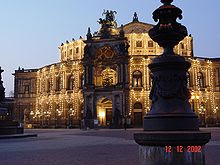 many others.
Since about 1970, Germany has once again had a thriving popular culture, now increasingly being led by its new-old capital Berlin and the city of Hamburg, and a self-confident music and art scene. Germany is also very well known for its many renowned opera houses, such as Semperoper, Komische Oper Berlin and Staatstheater am Gärtnerplatz. Richard Wagner has built the Bayreuth Festspielhaus.
Cuisine
Main article: German cuisine
Berliners are a typical German pastryGerman cuisine varies from region to region, but concentrates on meat and varieties of sweet desserts and cakes (such as Black Forest gateau Schwarzwälder Kirschtorte) and Stollen (a fruit cake). Germans also are famous for rye bread. Germany also produces a large quantity of beer, and (mostly white) wine, particularly Riesling, but also Müller-Thurgau and other varieties.
German cuisine is very similar to English and American cuisine and also to the cooking styles of its immediate neighbors (The Netherlands, France, Austria, Poland). Although sausage is the most famous food product from Germany, one could not gain much understanding of German cuisine by reducing it to sausage. In Germany it is mostly consumed as a snack (Bratwurst), at barbecues and it also appears in a few dishes. A stereotypical German dish contains a type of meat (typically pork, beef or poultry), a type of potatoes (mashed, fried, as dumplings or boiled) and a type of vegetable (typically peas, carrots or cabbage) and sauce. The "home cuisine" differs very much from the "restaurant cuisine". More traditional dishes can be found in restaurants. Cuisine differs also greatly according to regions (in the north people eat fish, in the Rhine region beer is replaced with wine, in Bavaria roasted pork is consumed) and season (in spring people eat white asparagus with ham and sauce hollandaise, in fall people eat green cabbage with a special kind of sausage and mustard and in winter/for Christmas people eat duck or goose with red cabbage, dumplings and brown gravy).
Sport
Main article: Sport in Germany
Opened in 2005: the Allianz Arena, one of the world's most modern football sta diums.Sport forms an integral part of German life, as demonstrated by the fact that 27 million Germans are members of a sports club and an additional twelve million pursue such an activity individually. Football is by far the most popular sport, and the German Football Federation (Deutscher Fußballbund) with more than 6.3 million members is the largest athletic organisation in the country. It also attracts the greatest audience, with hundreds of thousands of spectators attending Bundesliga matches and millions more watching on television. The other two most popular sports in Germany are marksmanship and tennis represented by the German Marksmen’s Federation and the German Tennis Federation respectively, both including more than a million members. Other popular sports include handball, volleyball, basketball, and ice hockey. Germany has historically been one of the strongest contenders in the Olympic Games. In the 2008 Summer Olympics, Germany finished fifth overall, whereas in the 2006 Winter Olympics Germany finished first.
Architecture
 Further information: German architecture
Architectural contributions from Germany include the Carolingian and Ottonian styles, important precursors of Romanesque. The region then produced significant works in styles such as the Gothic, Renaissance and Baroque. The nation was particularly important in the early modern movement through the Deutscher Werkbund and the Bauhaus movement identified with Walter Gropius. The Nazis closed these movements and favoured a type of neo-classicism. Since World War II, further important modern and post-modern structures have been built, particularly since the reunification of Berlin.
Religious tradition
Main article: Religion in Germany
Picture of Benedikt XVI.

Portrait of Martin LutherThe German government has limited responsibilities for culture, which is devolved to the states of Germany, called Länder.
64.1 percent of the German population belongs to Christian denominations. 31.4 percent are Roman Catholic, and 32.7 percent are affiliated with Protestantism. The North and East is predominantly Protestant, the South and West rather Catholic. Nowadays there is a non-religious majority in Hamburg and the East German states. Germany formed a substantial part of the Roman Catholic Holy Roman Empire, but was also the source of Protestant reformers such as Martin Luther. Historically, Germany had a substantial Jewish population. Only a few thousand people of Jewish origin remained in Germany after the Holocaust, but the German Jewish community now has approximately 100,000 members, many from the former Soviet Union. Germany also has a substantial Muslim minority, most of whom are from Turkey.
German theologians include Luther, Melanchthon, Schleiermacher, Feuerbach, and Rudolf Otto. Also Germany brought up many mystics including Meister Eckhart, Rudolf Steiner, Jakob Boehme, and some popes (e.g. Benedict XVI).
Academic landmarks
The Semperoper Saxon State Opera HouseGermany is home to some of the finest academic centers in Europe. Some famous Universities include those of both Munich and Berlin, University of Tübingen, University of Göttingen, University of Marburg, University of Berlin, Heidelberg University, Mining Academy Freiberg and Freiburg University, among
 many others.
Since about 1970, Germany has once again had a thriving popular culture, now increasingly being led by its new-old capital Berlin and the city of Hamburg, and a self-confident music and art scene. Germany is also very well known for its many renowned opera houses, such as Semperoper, Komische Oper Berlin and Staatstheater am Gärtnerplatz. Richard Wagner has built the Bayreuth Festspielhaus.
Cuisine
Main article: German cuisine
Berliners are a typical German pastryGerman cuisine varies from region to region, but concentrates on meat and varieties of sweet desserts and cakes (such as Black Forest gateau Schwarzwälder Kirschtorte) and Stollen (a fruit cake). Germans also are famous for rye bread. Germany also produces a large quantity of beer, and (mostly white) wine, particularly Riesling, but also Müller-Thurgau and other varieties.

German cuisine is very similar to English and American cuisine and also to the cooking styles of its immediate neighbors (The Netherlands, France, Austria, Poland). Although sausage is the most famous food product from Germany, one could not gain much understanding of German cuisine by reducing it to sausage. In Germany it is mostly consumed as a snack (Bratwurst), at barbecues and it also appears in a few dishes. A stereotypical German dish contains a type of meat (typically pork, beef or poultry), a type of potatoes (mashed, fried, as dumplings or boiled) and a type of vegetable (typically peas, carrots or cabbage) and sauce. The "home cuisine" differs very much from the "restaurant cuisine". More traditional dishes can be found in restaurants. Cuisine differs also greatly according to regions (in the north people eat fish, in the Rhine region beer is replaced with wine, in Bavaria roasted pork is consumed) and season (in spring people eat white asparagus with ham and sauce hollandaise, in fall people eat green cabbage with a special kind of sausage and mustard and in winter/for Christmas people eat duck or goose with red cabbage, dumplings and brown gravy).
Sport
Main article: Sport in Germany
Opened in 2005: the Allianz Arena, one of the world's most modern football sta
 diums.Sport forms an integral part of German life, as demonstrated by the fact that 27 million Germans are members of a sports club and an additional twelve million pursue such an activity individually. Football is by far the most popular sport, and the German Football Federation (Deutscher Fußballbund) with more than 6.3 million members is the largest athletic organisation in the country. It also attracts the greatest audience, with hundreds of thousands of spectators attending Bundesliga matches and millions more watching on television. The other two most popular sports in Germany are marksmanship and tennis represented by the German Marksmen’s Federation and the German Tennis Federation respectively, both including more than a million members. Other popular sports include handball, volleyball, basketball, and ice hockey. Germany has historically been one of the strongest contenders in the Olympic Games. In the 2008 Summer Olympics, Germany finished fifth overall, whereas in the 2006 Winter Olympics Germany finished first.
Labels: posted by MzMz-