
<body><script type="text/javascript"> function setAttributeOnload(object, attribute, val) { if(window.addEventListener) { window.addEventListener('load', function(){ object[attribute] = val; }, false); } else { window.attachEvent('onload', function(){ object[attribute] = val; }); } } </script> <div id="navbar-iframe-container"></div> <script type="text/javascript" src="https://apis.google.com/js/platform.js"></script> <script type="text/javascript"> gapi.load("gapi.iframes:gapi.iframes.style.bubble", function() { if (gapi.iframes && gapi.iframes.getContext) { gapi.iframes.getContext().openChild({ url: 'https://www.blogger.com/navbar/7111144625878141333?origin\x3dhttp://culture-in-a-small-world.blogspot.com', where: document.getElementById("navbar-iframe-container"), id: "navbar-iframe" }); } }); </script>
Culture and the world ♥
Wednesday, July 28, 2010

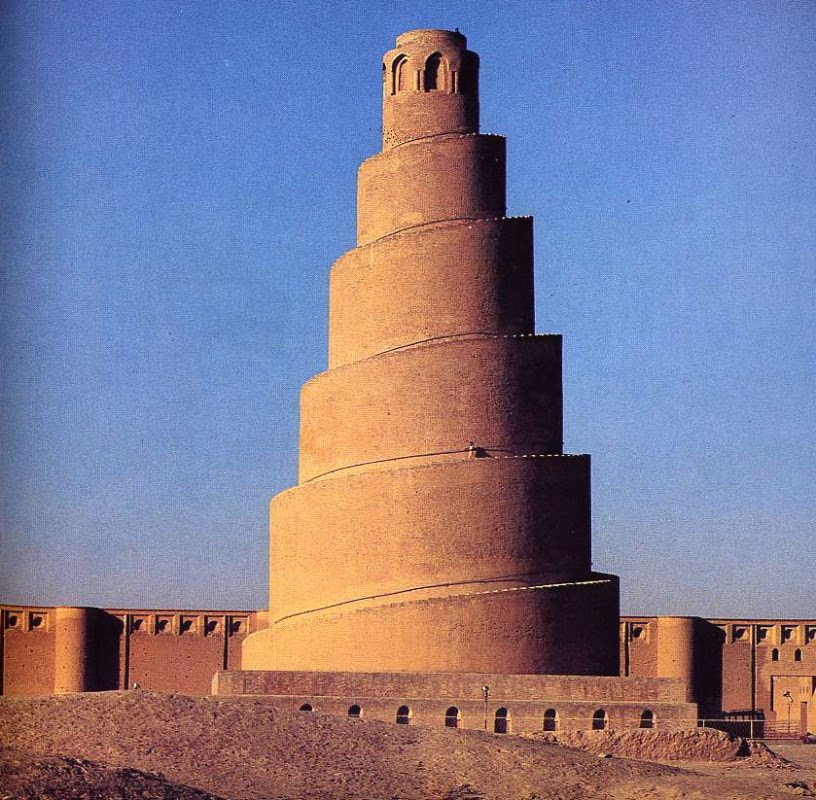
Great Mosque Samarra
Iraq had the world's oldest cultural histories. Ancient Mesopotamian civilizations influenced and shaped on it in its ancient world. Iraq was well-known for its poets, painters and sculptors, which were the most famous factors among the Arab World, and some of their distinct things were even marked as world-class. Since Iraq has a wide and variety of heritage, this country is like a home to Muslims, Christians, Jews, Assyrians and some countries around it.
The mosque from the left is a famous mosque called Samarra located in Iraqi city of Samarra. This mosque is completed in 851 the Abbasid caliph Al-Mutawakkil who reigned (in Samarra) from 847 until 861. This temple was a largest mosque in the world at one time. The art and architecture of the mosque was influential, especially the carving within the mosque in floral and geometric designs reveal the early Islamic decorations. In addition, the mosque of Ibn Tulun in Cairo, Egypt was based on the Samarra mosque in many regards.But in April 1, 2005, its top region was damaged by the bomb.
The Mosque of Ibn Tulun

Labels:

Leave your comments here (1)
Tuesday, July 27, 2010

HISTORY OF KHMER VERSION TEMPLE; ANGKOR WAT


The Angkor Wat or Angkor Vat Temple
or The Khmer Empire was the most powerful kingdom in Southeast Asia, which in now Cambodia, flourishing from 9th to 13th Century. This empire had ruled the modern day countries such as Laos, Myanmar, Thailand, Malay and Vietnam, and this grew out of the former kingdom of Chenla. At the beginning of the empire, the religions were Hinduism and Mahayana Buddhism, till Theravada Buddhism, introduced from Sri Lanka, prevailed. The Angkor Wat temple was built for the King Suryavarman during 12th Century. Even though this temple is a Buddhist temple, it's different from the temples nowadays. This is because the Angkor Wat temple was inspired by the 12th Century Hinduism. So, this temple was firstly revered by the Hinduism, then dedicated to the god Vishnu, and finally to Buddhist. The temple is the epitome of the high classical style of Khmer architecture. It has become a symbol of Cambodia, appearing on its national flag, and it is the country's prime attraction for visitors.


The Lost Temple: Lost City of Angkor Wat

Labels:

Leave your comments here (3)
Saturday, June 26, 2010

HAWAIIANS' HULA DANCE & ANCIENT HAWAIIAN TIKI GODS


Hawaii, which became the latest state of USA in August 21, 1959, is a group of 19 islands and is 2300 miles away from mainland. Though the islands have been a part of the USA since 1898 they constituted a territory rather than a state.

Nowadays, Hawa
ii is famous for its beautiful culture and scenery. Among its culture, I want to describe about their Hula dance, which is developed by the Native Hawaiians or indigenous Polynesian. Hula dancing is a complex art form, as they want to signify the aspects of nature such as the Basic Hula and Coconut Tree motions or basic leg steps. So, Hula dance is unlike any other dance, and this culture becomes the major tourist for Hawaiians.

Another interesting about them is their ancient Tiki Gods.
In their myth, because of the powerful spew from the volcanoes, their land had filled with amazing thing and their history with Tiki Gods. Ancient oracle of Hawaii perched on volcanic cliffs and carved the wooden Tikis peering through the rain-forest. These Tiki Gods temple were located in the Hawaiian Tiki villages and islands. They were worshiped through human sacrifice and chants(for health, weather and love) prayers and lava sledding. That's why, ancient Hawaiian world was a myth land being frightened from Tiki masked warriors.

Here's the Hawaii Hula Dance


Labels:

Leave your comments here (11)
Thursday, June 24, 2010

AMAZING ESKIMOS

"Eskimo" is an American Indian word which translates to "eaters of raw meat."There are two main types of Eskimo : Yupik and Inuit. The Yupik language dialects and cultures in Alaska and eastern Siberia have evolved in place beginning with the original (pre-Dorset) Eskimo culture that developed in Alaska. The earliest known Eskimo cultures were Pre-Dorset Technology, which appear to have been a fully developed Eskimo culture that dates to 5,000 years ago.Eskimos lived in some of the world's coldest areas near the Arctic Circle. The weather is so cold that they wear animal skinned provided clothes, especially caribou because of its warm and lightweight quality.

One of the amazing things for Eskimos is a Dog Sledge, which technique had been used since 10th Century. As they live
on snow or ice, a wheel-less vehicle, i.e. a dog sledge pulled by dogs is like the main transportation. Racing sled dogs will travel up to an average 20 mph (32 km/h) over distances up to 25 miles (40 km). But, to be able to use those dogs as sled dogs, they also need to be trained. Since dog sledges are very useful for those people, sled-dog-teams are also put in a great care. But, nowadays, sled dogs can also be found in cold countries like Germany and Japan.

Labels:

Leave your comments here (8)
Wednesday, June 23, 2010

THE BELIEF OF THE EGYPTIAN ANCIENT WORLD

I want to share some knowledge about Ancient Egyptians why they built pyramids. During the Old Kingdom of Egypt, the Pharaoh established the kingdom on the fertile Nile Valley. They believed that when a Pharaoh died, they became Osiris, which means the king of dead, and the new Pharaoh became Horus, the king of heaven and protector of the Sun. This circle symbolized the rising sun and setting sun. But, the main reasons they built the pyramids were that they had a belief that some part of the spirit, called ka, still
remained inside the dead body of Pharaoh. So, they thought that if they don't take care the dead body, the owner of that dead body, the former Pharaoh, would not be able to perform well in his tasks as the king of death. So, the circle would be broken and the kingdom would not be stable anymore because of the disaster. Thus, in order to prevent such catastrophe, they mummified the body of dead Pharaoh and put inside the Pyramid all together with vessels made of clay, stone, and gold, furniture, food, even doll-like representations of servants, known as ushabti. They put such things with the mummy as they believed that they would provide the King in his afterlife.

Labels:

Leave your comments here (5)
Tuesday, June 22, 2010

BULLFIGHTING IN SPAIN

This is one of the culture in Spain. Bullfighting is one of the festival called Fiesta Nacional (The National Sport). Its origins date back to 711AD, and Corrida (the first bullfight) was celebrated in honor of King Alfons VIII. But, this had changed when Felipe V prohibited this sport since he felt that it was a bad example for public's education. From that time on, even though they still celebrate that festival, facing the bulls is just unarmed, and then take them back to the place they were released.

But around 1724, this game is so severe and a very dangerous challenge for the bullfighter. This game is like dead or alive : human may win or lose. As you can see in the right side, some spears are put on the bulls so that bullfighter can also use those spears when he needs and eventually those spears are placed into the bull. But if one wrong, bullfighters will end up gored or seriously injured.

Labels:

Leave your comments here (7)
Monday, June 21, 2010

Kyaik Htee Yoe, one of the famous pagodas in Myanmar

Kyaik Htee Yoe pagoda is not only one of the famous pagodas but also major tourist attraction in Myanmar. Many foreigners are willing to visit this pagoda because of it's interesting history. This one is pretty interesting and this story took place over 2500 years ago. The tradition said that this relic is a hair of Gotama Buddha given to a hermit residing on the mountain by the Buddha himself as he was returning from the second heaven of the Nats whither he had gone to preach the law to his mother. Then the hermit enshrined it in the stupa on top of the rock.It's pretty interesting that the rock wights 611.5 tons but it doesn't fall down form the cliff as you can see in the photo.


Next thing is that if you make visit to Kyaik Htee Yoe, you can feel the beauty of the nature because the trail is made across the rain forest. Along the way, you can also learn about the culture of Myanmar people _ how they live and how they make their living, especially the villagers.(:


If you reach there, another place you must not fail to pay a visit is the pleasant Waterfall. Fortunately, if the day you travel to Kyaik Htee Yoe is one the festival days, you can enjoy both the festival and Myanmar cuisine.

Labels:

Leave your comments here (5)